
Behind the File: California Employee Record Rights
Employees Have a Right to Some of Their Employment Records
For the Labor Commissioner’s FAQs on what documents must be provided, see its official responses here, particularly at #6 and 7: DLSE Right to Inspect FAQs
Personnel File Requests Under California Labor Code § 1198.5
California employees have important rights to access records concerning their employment. California Labor Code § 1198.5 gives current and former employees—or their authorized representatives—the right to inspect and obtain copies of certain personnel records maintained by an employer.
These rights can be particularly important when an employee is evaluating a workplace dispute, reviewing the circumstances surrounding discipline or termination, investigating potential wage-and-hour violations, or simply seeking a complete record of their employment history.
What Is Included in a Personnel File?
For purposes of Labor Code § 1198.5, a “personnel file” is not necessarily limited to a single folder bearing that label. The statute applies to personnel records relating to an employee’s performance or to a grievance concerning the employee, as well as education and training records covered by the statute.
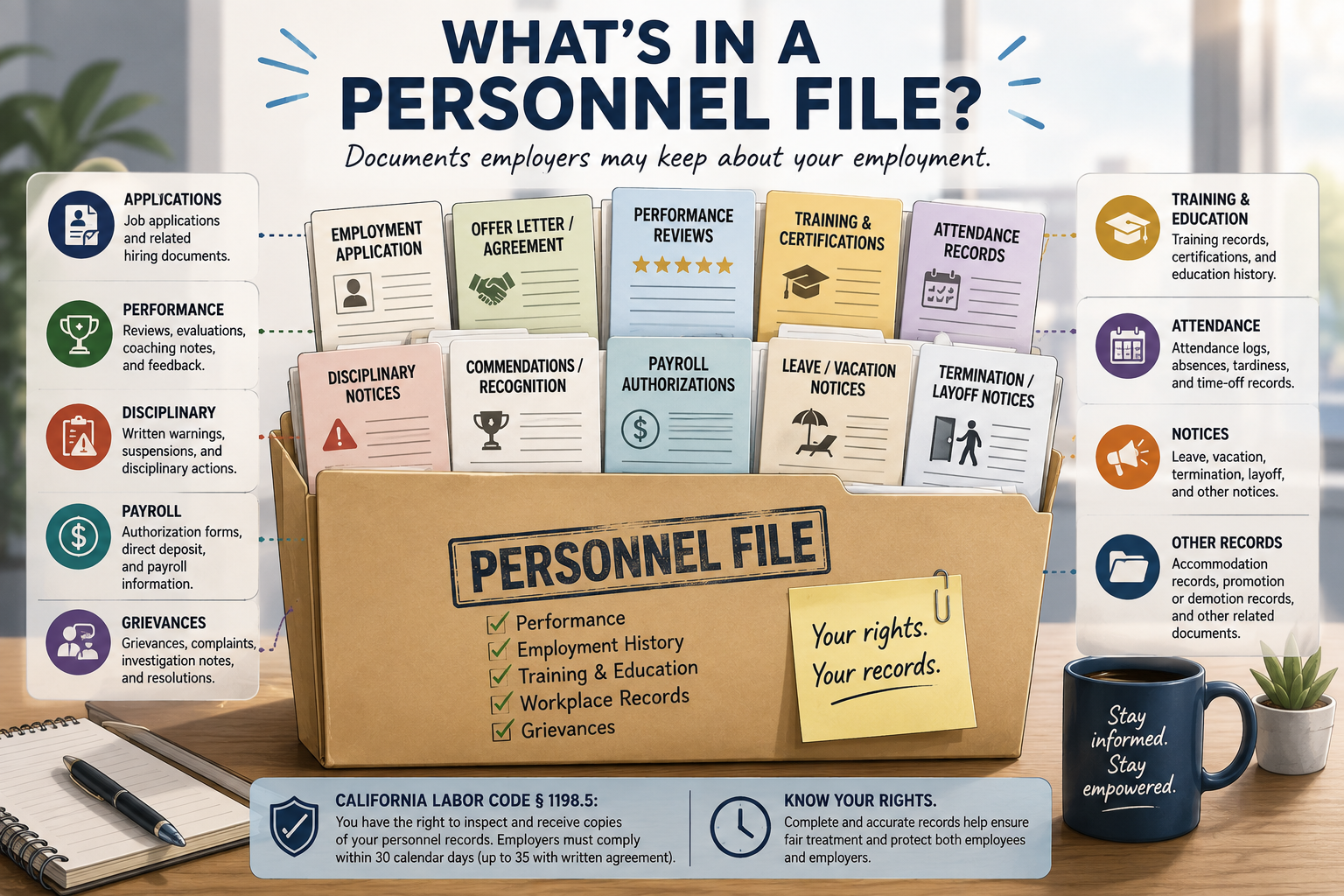
Depending on the employer’s recordkeeping practices and the circumstances, relevant personnel records may include:
Employment applications and related hiring documents;
Performance evaluations and reviews;
Written warnings and disciplinary notices;
Commendations and recognition;
Coaching and corrective-action records;
Promotion or demotion records;
Termination and layoff notices;
Attendance-related records;
Leave and vacation documentation;
Education and training records; and
Grievances and other records concerning an employee’s performance or workplace conduct.
In an employment dispute, these records can provide important context regarding the employer’s decisions and the employee’s work history.
2026 Update: Education and Training Records
Effective January 1, 2026, Labor Code § 1198.5 expressly includes certain education and training records within the personnel records employees have a right to inspect and receive.
This addition can be significant in employment disputes. Training records may help establish whether an employee received appropriate instruction before being disciplined for an alleged performance deficiency, whether required safety or harassment-prevention training occurred, whether workplace standards were applied consistently, or whether an employee possessed qualifications relevant to a promotion or position.
When an employer maintains covered education or training records, California law requires those records to contain specified information concerning the training, including information identifying the employee, training provider, dates and duration of training, competencies or subjects addressed, and resulting certifications or qualifications, as applicable.
How to Request Personnel Records
Although employees should review the particular statutory requirements that apply to their circumstances, making a personnel records request in writing generally creates a clear record of what was requested and when the employer received the request.
A written request may be submitted to human resources or another company representative designated to receive personnel-record requests.
The request should clearly state that the employee or former employee is seeking inspection and/or copies of personnel records pursuant to California Labor Code § 1198.5. The employee may also specifically identify performance, grievance, education, and training records to help clarify the scope of the request.
Employees seeking a more complete employment record may separately request payroll records under Labor Code § 226 and copies of employment-related documents they signed under Labor Code § 432.
Deadline for Producing Personnel Records
An employer generally must make personnel records available for inspection or provide copies within 30 calendar days after receiving a written request.
The employer and employee may agree in writing to extend the deadline, but the agreed-upon date generally may not extend beyond 35 calendar days from the employer’s receipt of the request.
Employers may charge the employee only the actual cost of reproducing the personnel records. When a former employee requests that copies be mailed, the employer may also require reimbursement for actual postal expenses.
California employers generally must maintain personnel records for at least three years after an employee’s termination.
Limitations and Exceptions
The right to inspect personnel records is substantial, but it is not unlimited.
Labor Code § 1198.5 contains several limitations and exclusions. For example, a former employee generally may make only one request per year to inspect or receive copies of personnel records under the statute.
Employers may also take reasonable steps to verify the identity of the person making the request or confirm that a representative has authority to act for the employee. Certain information, including the names of nonsupervisory employees, may be redacted under appropriate circumstances.
Certain records are excluded from the statute’s inspection requirements, including:
Records relating to the investigation of a possible criminal offense;
Letters of reference; and
Certain examination or rating materials used in connection with obtaining employment, promotion, or other employment-related qualifications.
Different rules may also apply to employees covered by qualifying collective bargaining agreements.
Additionally, when an employee files a lawsuit against an employer concerning a personnel matter, the statutory right to inspect or copy records under § 1198.5 may be suspended while the lawsuit is pending. Relevant documents may nevertheless be obtainable through the formal discovery process.
What Happens if an Employer Fails to Comply?
An employer that fails to permit inspection or copying within the time required by Labor Code § 1198.5 may face statutory consequences.
The employee, former employee, or Labor Commissioner may recover a $750 statutory penalty for a qualifying violation. A current or former employee may also seek injunctive relief to obtain compliance and may be entitled to recover costs and reasonable attorney’s fees.
These remedies make personnel-record compliance more than an administrative formality. Employers should establish reliable procedures for receiving, reviewing, and timely responding to employee record requests.
Payroll Records Under California Labor Code § 226
Personnel records are only one category of employment documents employees may have a right to obtain.
California Labor Code § 226 establishes important rights concerning wage statements and payroll records.
California employers generally must provide employees with itemized wage statements containing specified information, including:
Gross wages earned;
Total hours worked, subject to statutory exceptions;
Required deduction information;
Net wages earned;
Inclusive dates of the pay period;
Required employee identifying information;
The employer’s legal name and address; and
Applicable hourly rates and corresponding hours worked at each rate.
Employers generally must retain copies of wage statements or records of deductions for at least three years.
Requesting Payroll Records
A current or former employee may request to inspect or receive copies of records covered by Labor Code § 226.
The employer must generally comply as soon as practicable, but no later than 21 calendar days after the request.
Failure to permit inspection or copying within the statutory period may result in a $750 penalty. An employee may also seek injunctive relief and, when authorized by the statute, recover costs and reasonable attorney’s fees.
Payroll records can be particularly important in disputes involving:
Unpaid overtime;
Missed meal or rest period premiums;
Unpaid minimum wages;
Incorrect wage rates;
Unlawful deductions;
Misclassification;
Unpaid commissions;
Final wages; and
Inaccurate wage statements.
Comparing payroll records against schedules, time records, employment agreements, and other documentation may reveal discrepancies that are not apparent from a single pay stub.
Signed Employment Documents Under California Labor Code § 432
California Labor Code § 432 provides another important record-access right.
Under § 432, an employee or applicant who signs an instrument relating to obtaining or holding employment is entitled, upon request, to receive a copy of that document.
Depending on the employment relationship, these documents may include:
Employment applications;
Offer letters;
Employment agreements;
Arbitration agreements;
Commission or compensation agreements;
Confidentiality agreements;
Handbook and policy acknowledgments;
Signed job descriptions;
Disciplinary documents signed by the employee;
Training acknowledgments; and
Separation or termination agreements.
This right can be particularly important because employees do not always retain copies of documents presented during hiring, onboarding, changes in compensation, discipline, or separation.
Should Employees Request Records Under All Three Statutes?
In many circumstances, requesting records under Labor Code §§ 1198.5, 226, and 432 can provide a more complete picture of the employment relationship.
Each statute addresses a different category of records:
Section 1198.5
Covers: Personnel, performance, grievance, education, and training records
Key Right: Inspection and copies
Section§ 226
Covers: Wage statements and specified payroll records
Key Right: Inspection and copies
Section§ 432
Covers: Employment-related documents signed by the employee or applicant
Key Rights: Copy upon request
A personnel file may not contain every agreement an employee signed. Payroll records may not contain disciplinary or performance documents. Likewise, signed employment documents may not contain timekeeping or wage information.
Requesting the applicable categories together can therefore provide a more comprehensive employment record.
Practical Tips for Requesting Employment Records
Employees seeking employment records should consider several practical steps:
Make the request in writing. A written request creates documentation of both the request and its scope.
Identify the statutes involved. Clearly identifying Labor Code §§ 1198.5, 226, and/or 432 can reduce uncertainty about the records being requested.
Keep a copy of the request. Preserve the email, letter, delivery confirmation, and any employer response.
Track applicable deadlines. The statutory response period differs depending on the type of records requested.
Review the production carefully. Determine whether expected documents appear to be missing or incomplete.
Preserve the records. Employment documents may become important if a dispute later develops.
Exercise caution before signing additional documents. An employee should carefully review any release, waiver, acknowledgment, or agreement presented in connection with a records request.
Employees may wish to consult an employment attorney when an employer refuses to provide records, misses a statutory deadline, produces an incomplete file, claims relevant records do not exist, conditions production on signing a release, or produces records raising concerns about discrimination, retaliation, harassment, wrongful termination, unpaid wages, misclassification, or other potential violations.
Employment Records Can Tell an Important Story
Employment records often provide more than a historical account of an employee’s time with a company. They can help explain what happened, when it happened, what the employer documented, and whether the employer’s records are consistent with its stated reasons for taking action.
Personnel records may reveal a history of positive performance followed by unexpected discipline. Payroll records may uncover unpaid wages or inconsistencies in hours and rates of pay. Training records may show whether an employee received the instruction the employer later claimed was required. Signed agreements may identify arbitration provisions, compensation arrangements, or other terms affecting the employee’s legal rights.
For employers, these same records underscore the importance of consistent documentation, accurate recordkeeping, and timely responses to statutory requests.
Havey Law Offices Can Help
Havey Law Offices LLC provides guidance concerning California employment records, personnel-file requests, wage-and-hour matters, and other workplace issues.
If questions arise concerning an employer’s response to a personnel or payroll records request—or if the records reveal potential employment-law concerns—consider having the documents reviewed before taking further action.
By: Heath A. Havey
Heath has been advising companies in California, Nevada, Japan, and U.S. employment laws since 1998.
Havey Law Offices LLC provides experienced legal guidance on California employment law and workplace compliance. Contact us today to discuss your company’s legal obligations, address potential compliance concerns, and develop practical strategies to reduce risk and maintain compliance with California employment laws.
Legal Disclaimer
The information provided on this blog is for general informational purposes only and does not constitute legal advice. Reading this blog, commenting on posts, or contacting the author through this website does not create an attorney–client relationship.
While we strive to ensure the accuracy and timeliness of the content, laws and regulations change frequently, and the information may not reflect the most current legal developments. You should consult a qualified attorney licensed in your jurisdiction before making any legal decisions or taking any action based on the information provided here.
The author and this blog disclaim all liability for any actions taken or not taken based on the content of this site. Use of this blog is at your own risk.