
Is Your Handbook Ready for 2027?Why California Employers Should Update Now, and Why One Size No Longer Fits All
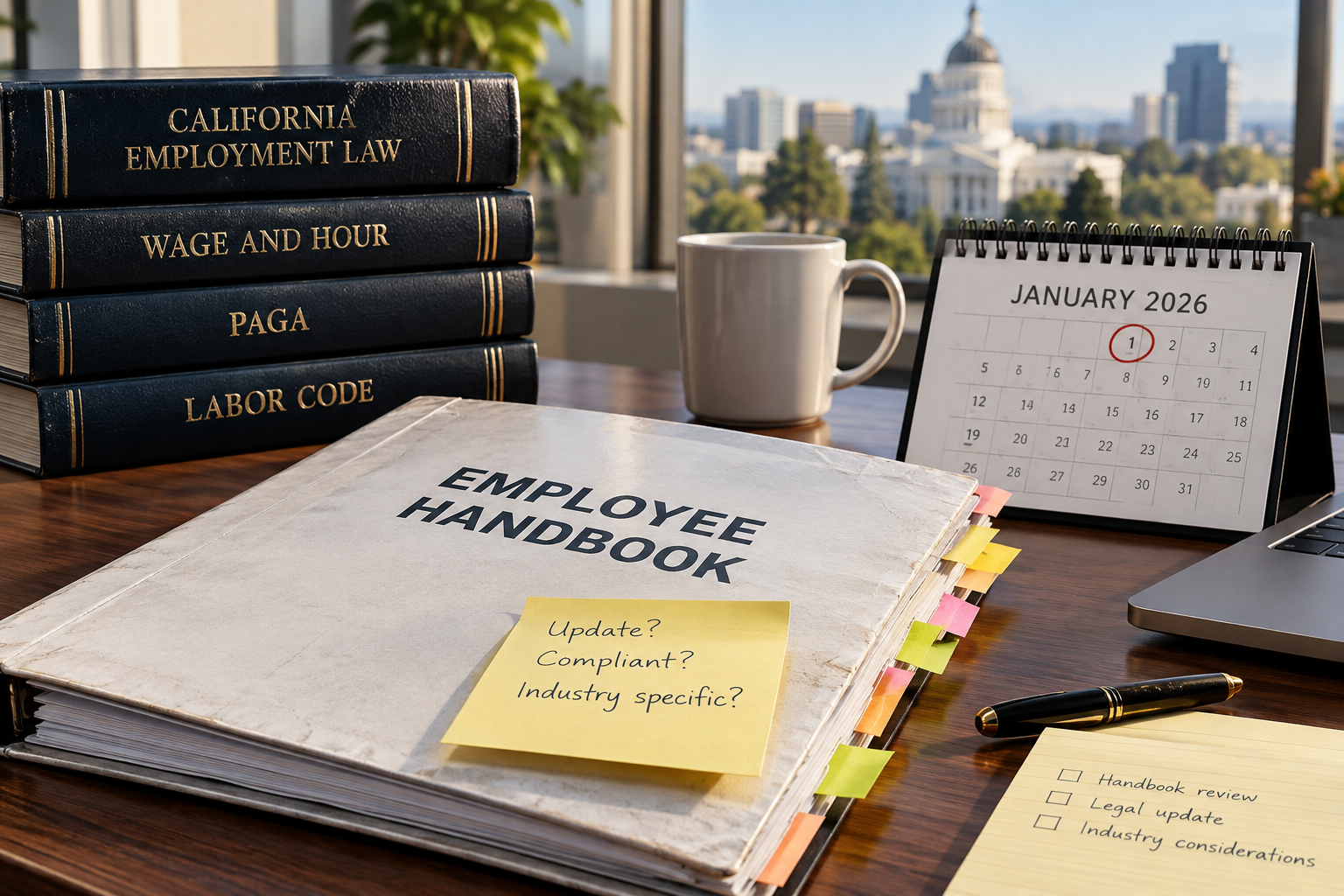
The handbook sits in a shared drive. It was updated a few years ago. Maybe it came from a template. Maybe a prior attorney drafted it for a company that looked a little like yours.
Everyone signed the acknowledgment.
Nobody has looked at it since.
For many California employers, this is the reality. And it is understandable. Running a business leaves little time to reread policies that seem to be working.
But a handbook that seems to be working may simply be one that has not yet been tested.
The Law Keeps Moving. The Handbook Usually Doesn’t.
California adds new employment laws every year, and most take effect on January 1. Some are small adjustments. Others change how leave works, how employees are paid, or what employers must tell their workers in writing. Minimum wage and the salary threshold for exempt employees change every year as well, and many cities set their own rates on top of the state’s.
Each change by itself may seem minor. Over three or four years, they add up.
The result is a handbook that describes a set of rules that no longer exists. It may promise less leave than the law requires. It may include a policy that was lawful when written but is not today. It may say nothing at all about obligations that did not exist when it was drafted.
Yesterday’s compliant policy may not answer tomorrow’s requirements.
Why This Matters More Than It Used to
Imagine an employee files a wage claim. The claim itself is modest.
Then the employee’s attorney asks for the handbook.
If the meal and rest break policy is outdated, or the sick leave policy uses old numbers, the claim is no longer about one employee. It may now be about every employee who worked under that policy, for every pay period, for years. That is how a single complaint becomes a class action or a PAGA case. And because California’s wage and hour laws generally require employers to pay the employees’ attorneys’ fees when employees prevail, even a modest victory for the plaintiffs can lead to six figures or more in attorneys’ fees alone.
The reverse is also true. In many areas of California employment law, the employer carries the burden of proof. A current, lawful handbook, signed by each employee, is often the first and best evidence an employer has: that the rules were clear, that employees knew them, and that the company took reasonable steps to comply.
A handbook is not just an HR document. It is part of the defense.
One Size No Longer Fits All
Many handbooks are written as if every business were an office.
But a restaurant is not an office. Neither is a farm, a retail store, a clinic, or a bank branch. Each industry has its own pressure points, and those are exactly where claims tend to arise.
Consider a few examples:
Restaurants deal with tips and tip pools, split shifts, uniforms, and food and alcohol service certifications.
Retailers deal with scheduling, security checks, cash handling, commissions, and seating.
Agricultural employers deal with piece-rate pay, heat illness prevention, field conditions, and labor contractors.
Technology companies deal with exempt classification of engineers, inventions, confidentiality, remote work, and the growing use of AI tools.
Health care employers deal with long shifts, on-call time, licensing, and patient privacy.
Financial institutions deal with regulators, background checks, recordkeeping, and conflicts of interest.
A generic handbook may mention none of these. Or worse, it may include policies written for a different kind of business that do not fit, and that no one follows.
That gap is a problem. When the written policy says one thing and the workplace does another, the difference becomes evidence.
The Policy Is Step One. The Practice Is Step Two.
Updating the handbook is not the finish line.
A handbook is only as good as the practices behind it. If the policy says employees take a timely meal break, the time records should show it. If the policy says expenses are reimbursed, they should be. If the policy describes a process for complaints, managers should know it and use it.
An industry-tailored handbook helps here too. When the policies reflect how your business actually runs, managers are more likely to follow them, employees are more likely to understand them, and the company is in a far better position to show that the rules were real.
“Our Handbook Is Fine.”
Maybe.
It is fair to say that not every older handbook is a problem. Some are well drafted, and some businesses change very little from year to year.
But “fine” is hard to know without looking. The question is not whether the handbook was good when it was written. It is whether it is accurate today, for this business, under this year’s laws.
What to Do Now
Check the date. If the handbook has not been reviewed in the last year, it likely needs updating.
Compare policy to practice. Ask whether the handbook describes how your business actually operates.
Look at your industry. Identify the issues specific to your type of business and confirm the handbook addresses them.
Check your locations. Confirm whether any city or county where your employees work has its own rules.
Collect new acknowledgments. Have each employee sign for the updated version.
The Bottom Line
The best time to update a handbook is before anyone asks to see it.
With a new set of California laws taking effect January 1, now is a natural time to review. A current handbook, tailored to how your business actually operates, is one of the simplest and most effective steps an employer can take to reduce risk.
Contact us today to discuss updating your employee handbook for 2027.
This article is for general information only and is not legal advice. Reading it does not create an attorney-client relationship.