
PAGA Reform Did Not Kill PAGA: What California Employers Should Be Doing Now
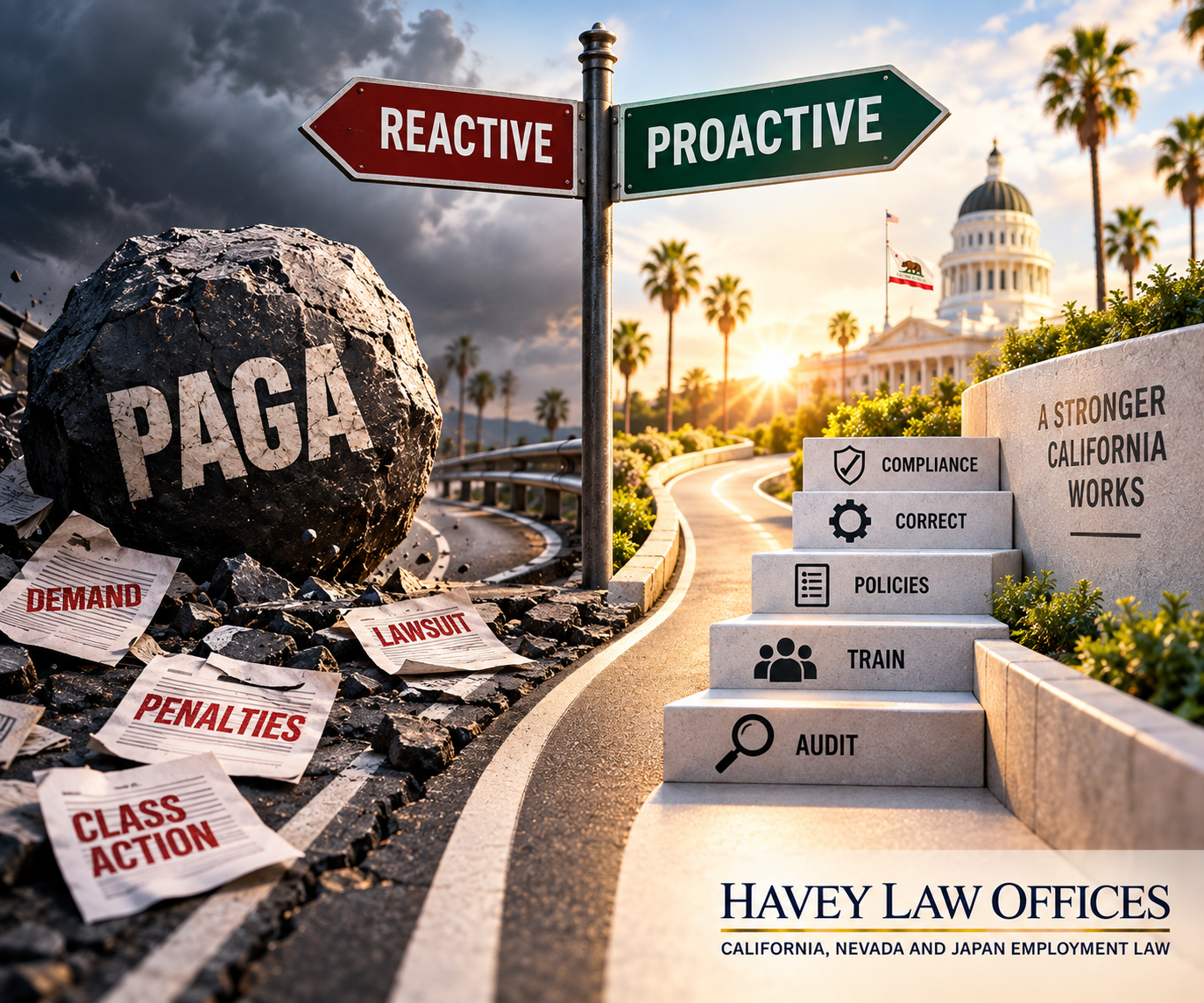
California substantially reformed the Private Attorneys General Act ("PAGA") in 2024. For employers, the reforms were significant. They created new opportunities to reduce penalties, expanded the ability to cure alleged violations, imposed additional standing requirements, and gave employers more reason to address wage-and-hour compliance proactively.
But employers should not confuse PAGA reform with PAGA elimination.
PAGA remains a significant source of California employment litigation. More importantly, the reforms changed the strategic value of compliance. An employer's efforts to comply with California wage-and-hour law before receiving a PAGA notice—and its response immediately afterward—can materially affect potential exposure.
For California employers, the lesson is straightforward:
PAGA compliance should begin before a PAGA notice arrives.
What Is PAGA?
California's Private Attorneys General Act allows an "aggrieved employee" to pursue civil penalties for Labor Code violations on behalf of the State of California.
This makes a PAGA action fundamentally different from an ordinary individual wage claim. An employee may allege Labor Code violations affecting other employees and seek civil penalties associated with those violations.
PAGA claims also frequently accompany other wage-and-hour claims, including claims involving:
Unpaid minimum wages or overtime;
Missed meal periods;
Missed rest periods;
Inaccurate wage statements;
Unreimbursed business expenses;
Off-the-clock work;
Improper timekeeping practices; and
Other alleged Labor Code violations.
Consequently, a seemingly minor payroll or timekeeping issue can become substantially more significant when the same practice affects many employees over numerous pay periods.
The 2024 PAGA Reforms Changed the Risk Analysis
In 2024, California enacted AB 2288 and SB 92, substantially modifying PAGA for notices and resulting actions filed on or after June 19, 2024.
Among other changes, the reforms altered the penalty structure, expanded cure opportunities, changed the allocation of recovered PAGA penalties, imposed additional standing requirements, and created procedures designed to encourage earlier resolution of alleged violations.
The reforms also introduced an especially important concept for employers:
"All Reasonable Steps"
The amended statute provides substantial incentives for employers that take "all reasonable steps" to comply with the Labor Code.
The statute identifies examples that may constitute reasonable steps, including:
Conducting audits concerning potential violations and responding appropriately to the results;
Implementing and distributing lawful written policies;
Training supervisors concerning Labor Code and wage-order compliance; and
Taking appropriate corrective action regarding supervisors.
Whether an employer took all reasonable steps depends on the totality of the circumstances, including such considerations as the employer's size and resources and the nature, severity, and duration of the alleged violation.
Importantly, the existence of a violation does not, by itself, establish that the employer failed to take reasonable steps.
That distinction can be extremely important.
California wage-and-hour law is complex. An employer may make an error despite meaningful compliance efforts. Under the reformed PAGA framework, there can now be a significant difference between an employer that made an error despite a genuine compliance program and an employer that did little or nothing to prevent the same problem.
The 15% and 30% Penalty Caps Give Compliance Real Value
One of the most significant features of PAGA reform concerns potential penalty reductions.
For qualifying PAGA matters, where an employer took all reasonable steps to comply before receiving the PAGA notice, the applicable PAGA civil penalty may generally be limited to 15% of the otherwise applicable penalty.
Where an employer had not already taken all reasonable steps but does so within 60 days after receiving the PAGA notice, the applicable penalty may generally be limited to 30% of the otherwise applicable penalty.
These rules are subject to statutory requirements and exceptions, so they should not be treated as automatic reductions.
Nevertheless, the practical significance for employers is substantial.
Before PAGA reform, an employer might have viewed a payroll audit primarily as a means of preventing future liability.
Today, the audit itself—and the employer's documented response to what the audit uncovers—may become important evidence concerning potential PAGA penalties.
Audit compliance has become part of the defense.
An Example: The Meal-Period Problem Nobody Noticed
Consider a hypothetical California employer with 175 nonexempt employees.
The company has a written meal-period policy that appears legally compliant. Employees are instructed to take timely 30-minute meal periods, supervisors receive the employee handbook, and employees clock their meal periods through the company's electronic timekeeping system.
But there is a problem.
One department has developed an informal practice under which employees sometimes delay their meal periods when business becomes busy. The written policy says one thing, but a supervisor regularly tells employees:
"Let's get through the rush first. You can take lunch afterward."
The payroll system contains hundreds of meal periods beginning after the fifth hour of work.
Nobody in management has reviewed the exception data.
Eventually, a former employee files a PAGA notice alleging systematic meal-period violations.
Employer A: No Compliance Infrastructure
Suppose Employer A has:
No meaningful wage-and-hour audit program;
No supervisor training regarding meal periods;
No procedure for reviewing late or missed meal periods;
No investigation of recurring timekeeping exceptions;
No corrective action involving supervisors; and
No documentation showing efforts to determine whether employees actually received compliant meal periods.
Employer A may now have to investigate years of practices under the pressure of a PAGA notice.
Employer B: Active Compliance Program
Now consider Employer B.
It has the same written meal-period policy, but it also:
Periodically audits time records;
Generates reports identifying late and missed meal periods;
Investigates recurring exceptions;
Trains supervisors not to discourage or interfere with meal periods;
Documents that training;
Corrects supervisors who violate the policy; and
Reviews whether required premiums have been paid when appropriate.
Assume an isolated supervisor nevertheless violates company policy.
The underlying violation may still require correction. But Employer B enters the dispute with something Employer A does not have:
Evidence of affirmative compliance efforts.
Under the post-reform PAGA framework, that distinction may matter when evaluating whether the employer took "all reasonable steps."
Written Policies Alone May Not Be Enough
Employers sometimes assume that a compliant handbook solves the problem.
It is certainly important. One might say that compliant policies in writing are a necessary, if not sufficient, aspect of proving compliance.
This is because a policy sitting in a handbook is only one part of a compliance system.
Suppose an employer's handbook correctly states that nonexempt employees must receive legally compliant meal and rest periods. But supervisors routinely discourage breaks to meet production targets. This is a problem of “practice” compared to “policy.”
The written policy and the workplace practice now point in opposite directions.
Similarly, an employer might have a lawful off-the-clock-work policy while managers routinely text employees after hours and expect immediate responses.
Or an employer might have a reimbursement policy while supervisors tell employees that submitting small expense reports is "not worth the trouble."
In PAGA and wage-and-hour litigation, employers should expect attention to focus not merely on what the policy says, but also on what actually happens in the workplace. The policy is step one of compliance; the practice is step two.
Employers Should Think Like Auditors Before They Have to Think Like Litigators
A useful PAGA-prevention program examines systems rather than merely isolated complaints.
Employers should consider periodically reviewing areas such as:
Timekeeping
Are employees clocking in before beginning work?
Are employees performing work after clocking out?
Are supervisors editing time records?
Are there recurring manual adjustments?
Do remote employees perform work outside recorded hours?
Meal Periods
Are first meal periods beginning on time?
Do particular locations, departments, shifts, or supervisors show unusual patterns?
Are short meal periods occurring?
Are employees being interrupted?
Are appropriate premiums being paid when legally required?
Rest Periods
Do policies accurately describe California rest-period requirements?
Are staffing levels sufficient to permit employees to take breaks?
Do supervisors understand that production demands do not simply override break requirements?
Regular Rate of Pay
Are nondiscretionary bonuses, commissions, shift differentials, and other forms of compensation being properly considered when calculating overtime and other required payments, including lunch period premiums?
Wage Statements
Do wage statements contain all information required by Labor Code section 226?
Does the employer periodically review the actual wage statement received by an employee rather than merely assuming its payroll provider's template is compliant?
Expense Reimbursement
Are employees using personal cell phones, vehicles, home internet, equipment, or other resources for business purposes?
If so, has the employer evaluated its reimbursement obligations?
Final Pay
Do HR and payroll understand California's rules concerning the timing of final wages?
Is there a reliable procedure for getting accurate information to payroll immediately after a termination?
These are precisely the types of recurring issues that can transform a small individual dispute into broader PAGA or class-action exposure. Final pay problems are often triggered as a derivative claim when some other wages have not been fully paid at the time of separation.
The PAGA Notice Arrived. What Should the Employer Do?
A PAGA notice should not simply be placed in the personnel file or treated like an ordinary demand letter.
Timing matters.
California's post-reform framework provides several procedures that may create opportunities for employers to address alleged violations early.
Depending on the employer's size, the alleged violations, and the procedural posture, these can include administrative cure procedures, wage-statement cure procedures, and a judicial early evaluation process.
For example, employers with fewer than 100 employees during the applicable one-year period may be able to submit a confidential proposal to the Labor and Workforce Development Agency ("LWDA") to cure certain alleged violations.
Employers of any size may have access to an administrative cure procedure for certain wage-statement violations.
For larger employers, and in certain other circumstances after litigation begins, the statutory framework provides for a judicial early evaluation conference.
Employers should therefore promptly determine:
1. When was the notice received?
Calendar all potentially applicable statutory deadlines immediately.
2. Exactly which Labor Code violations are alleged?
Do not assume that a lengthy notice necessarily establishes that the alleged practices actually occurred.
3. Which employees and practices may be implicated?
Determine the potentially affected workforce, locations, positions, supervisors, and relevant time period.
4. What does the employer's data show?
Preserve and analyze relevant timekeeping, payroll, wage-statement, policy, training, and personnel information.
5. Is the alleged violation continuing?
If a genuine compliance problem exists, allowing it to continue can make the situation worse.
6. Is a cure available?
The post-reform cure procedures should be evaluated promptly because important deadlines apply.
7. What compliance efforts existed before the notice?
Identify audits, policies, training, corrective actions, payroll reviews, and other evidence potentially relevant to the "all reasonable steps" analysis.
Cure Does Not Simply Mean "Fix It Going Forward"
One of the most important misconceptions employers can have is that curing a violation simply means changing the policy for the future.
The statutory cure analysis can require substantially more.
Depending on the alleged violation, an effective cure may require correcting the underlying practice, making affected employees whole, addressing wage statements, and taking other statutorily required actions.
This is where it becomes critical to have legal advice before attempting a self-cure.
Employers should therefore resist the temptation to fire off a quick response stating:
"We've fixed the problem."
The LWDA will require proof of a true cure, including backpay and other potential remedies.
The legal question is whether the employer has satisfied the applicable statutory cure requirements. That determination should be made carefully.
Small Employers Have a Specific Administrative Cure Opportunity
For PAGA notices subject to the reformed statute, an employer that employed fewer than 100 employees in total during the one-year period preceding the PAGA notice may submit a confidential cure proposal to the LWDA.
The proposal generally must be submitted within the applicable statutory period—currently 33 days after the PAGA notice—and the LWDA may hold a conference concerning the proposed cure.
This procedure can present a meaningful early-resolution opportunity for qualifying employers.
But it also makes immediate action particularly important. Also, if the cure notice is filed in the wrong department or is not complete, the LWDA may deem it untimely, even if the company tries to fix the misfiling.
Waiting several weeks before sending a PAGA notice to employment counsel may consume much of the time available to evaluate and pursue the procedure. Employment counsel should be retained immediately to examine these issues while there is time to take advantage of this opportunity.
Wage-Statement Claims Have Their Own Cure Procedure
California wage-statement claims under Labor Code section 226 are common components of PAGA litigation.
For qualifying wage-statement violations, employers of any size may use the administrative wage-statement cure process when that is the only type of violation the employer seeks to cure through that procedure.
The process includes specific notice and timing requirements.
This creates another reason employers should determine exactly what a PAGA notice alleges instead of treating all notices identically.
Larger Employers Should Understand Early Evaluation
For PAGA lawsuits based on notices filed on or after June 19, 2024, employers with 100 or more employees during the applicable period may request an early evaluation conference after litigation begins. Smaller employers may also request the process.
The procedure is intended to facilitate early evaluation and potential resolution, including consideration of proposed cures.
For an employer confronting a potentially substantial PAGA action, early evaluation can provide an opportunity to assess the actual practices, potential exposure, available defenses, and possible corrective measures before years of litigation occur.
Documentation May Be as Important as the Compliance Program Itself
Suppose an employer provides wage-and-hour training every year.
Who attended?
What subjects were covered?
Were supervisors specifically instructed concerning off-the-clock work, meal periods, rest periods, timekeeping, and expense reimbursement?
Was attendance documented?
What happened when a supervisor violated the policy?
If an employer cannot demonstrate that compliance measures occurred, their defensive value may be substantially diminished.
Employers should therefore consider retaining appropriate documentation concerning:
Wage-and-hour audits;
Corrective measures taken in response to audits;
Written policies and revisions;
Dates policies were distributed;
Employee acknowledgments;
Supervisor training;
Training attendance;
Payroll-system reviews;
Investigations of recurring exceptions;
Corrective action involving supervisors; and
Remediation of identified compliance issues.
The objective is not to manufacture evidence for future litigation.
It is to create a genuine compliance system—and preserve evidence showing that the system actually operates.
PAGA Reform Rewards Prevention
Perhaps the most important lesson from the 2024 reforms is philosophical.
California did not eliminate PAGA.
Instead, the Legislature created stronger incentives for employers to identify and correct Labor Code compliance issues.
That changes the calculation.
A periodic wage-and-hour audit is no longer valuable solely because it may identify an error before litigation.
Supervisor training isn't valuable solely because it may prevent a manager from making a mistake.
Corrective action isn't valuable solely because it stops a bad practice.
Under the current PAGA framework, these measures may also become relevant to demonstrating that an employer took all reasonable steps to comply with the law.
For employers, that means the best PAGA defense may begin months—or years—before anyone files a PAGA notice.
A Practical PAGA Compliance Checklist for Employers
California employers should consider incorporating the following into their ongoing employment-law compliance program:
Audit. Periodically examine wage-and-hour practices, not merely written policies.
Test the payroll system. Review actual calculations and actual wage statements.
Review time data. Look for patterns involving late meals, missed meals, edits, rounding, off-the-clock activity, and other exceptions.
Train supervisors. Front-line managers can unintentionally create wage-and-hour liability despite perfectly drafted HR policies.
Document training. Maintain records showing who received training, when, and on what subjects.
Investigate recurring exceptions. A repeated anomaly may indicate a workplace practice rather than an isolated mistake.
Correct identified problems. An audit that identifies violations without meaningful corrective action may provide little comfort.
Review compliance periodically. California employment law changes frequently. Yesterday's compliant policy may not answer tomorrow's requirements.
Escalate PAGA notices immediately. Cure and penalty-reduction opportunities can be time-sensitive.
Preserve evidence. Once a dispute arises, relevant payroll, timekeeping, policies, communications, and other records should be preserved.
The Bottom Line
PAGA reform created meaningful new protections and strategic opportunities for California employers.
But those protections favor employers that act.
The difference between an employer that can document audits, lawful policies, supervisor training, corrective action, and prompt remediation—and an employer that begins thinking about compliance only after receiving a PAGA notice—may now have direct consequences for potential PAGA exposure.
Employers should therefore approach PAGA as both a litigation issue and a compliance issue.
If a PAGA notice has already arrived, the employer should promptly evaluate the allegations, preserve relevant evidence, investigate the underlying practices, determine whether cure procedures are available, and assess whether the employer's prior and post-notice compliance measures qualify for the protections provided by the reformed statute.
If no PAGA notice has arrived, that may be the best time to prepare.
Havey Law Offices represents employers and management in California employment matters, including wage-and-hour counseling, PAGA actions, class actions, workplace investigations, and employment litigation.
California, Nevada and Japan Employment Law
Employer Counseling | Employment Litigation | PAGA & Class Action Defense
This article provides general information and is not legal advice. The application of PAGA and California wage-and-hour law depends on the particular facts and circumstances.