
No Break? Big Problem: California Meal & Rest Break Rules
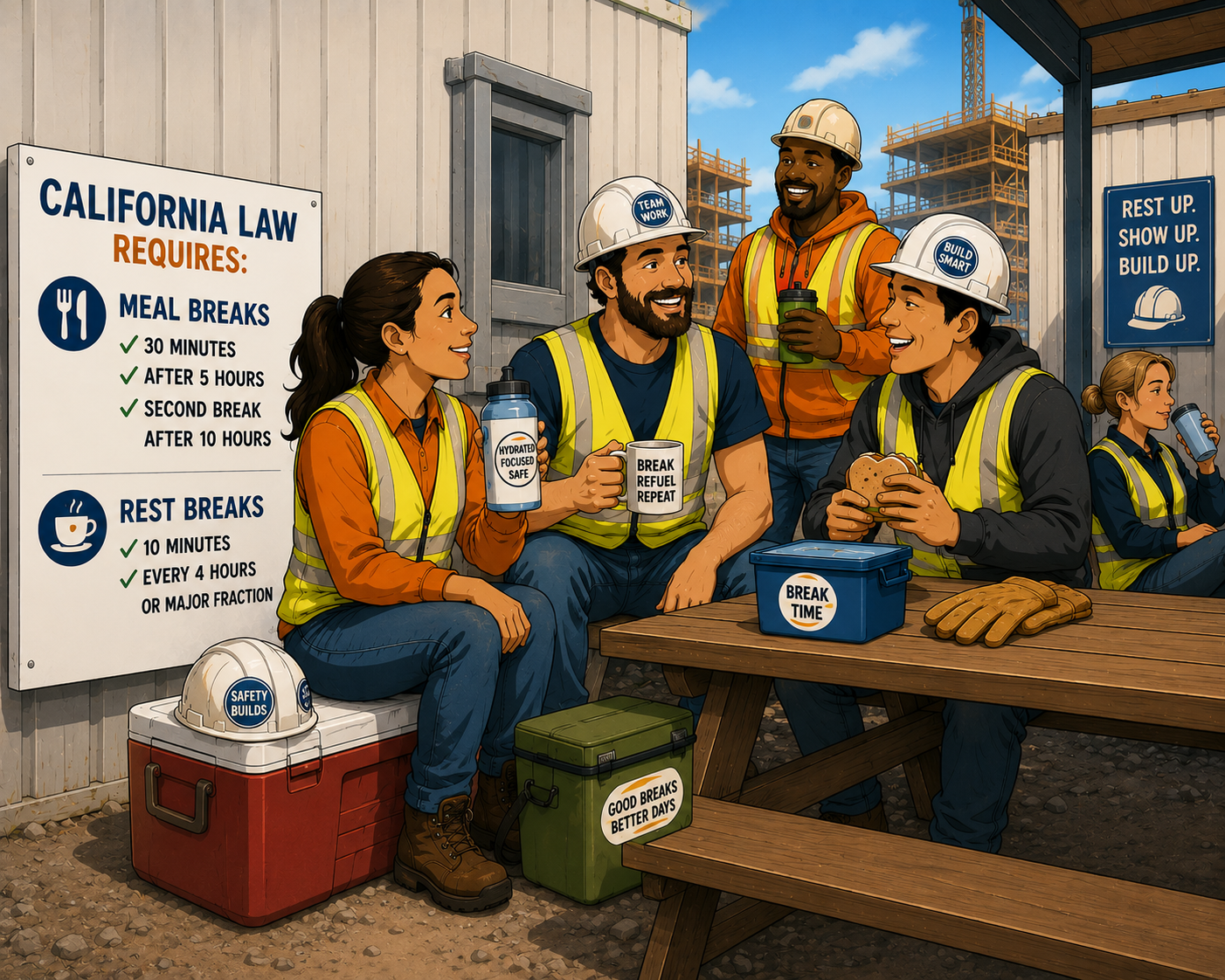
Give Me a Break! California Meal & Rest Break Laws
California law provides extensive meal and rest period protections for nonexempt employees. Although meal periods and rest breaks are often discussed together, they are governed by different requirements concerning when they must be provided, how long they must last, whether they are paid, and what remedies may apply when an employer fails to provide them.
For employers, understanding these distinctions is essential to maintaining compliant scheduling, timekeeping, and payroll practices. For employees, knowing the rules can help identify when a legally required break has been missed, shortened, interrupted, or improperly denied.
California Meal Break Requirements
California Labor Code section 512 and the applicable Industrial Welfare Commission (“IWC”) Wage Orders establish California’s principal meal-period requirements.
As a general rule, a nonexempt employee who works more than five hours in a workday must be provided with an uninterrupted meal period of at least 30 minutes.
The first meal period generally must begin no later than the end of the employee’s fifth hour of work.
A first meal period may generally be waived by mutual consent when the employee’s total workday does not exceed six hours.
Employees who work more than 10 hours in a workday are generally entitled to a second 30-minute meal period. The second meal period may be waived under specified circumstances when the employee works no more than 12 hours and the first meal period was not waived.
As a general framework:
Five hours or less: No meal period is ordinarily required.
More than five hours: One 30-minute meal period is generally required.
More than 10 hours: A second 30-minute meal period is generally required.
Industry-specific rules and exceptions may alter these requirements.
What Makes a Meal Period Compliant?
An off-duty meal period is generally unpaid. To qualify as an off-duty meal period, the employer must relieve the employee of all duties for the required period and relinquish control over the employee’s activities.
Employers must provide employees with a genuine opportunity to take an uninterrupted meal period. They may not pressure, encourage, or require employees to work through legally required meal periods.
California law does not generally require employers to police employees to ensure that no work is ever performed during a properly provided meal period. The employer’s obligation is to provide a compliant meal period and refrain from impeding or discouraging its use.
On-Duty Meal Periods
California permits on-duty meal periods only in limited circumstances.
Generally, an on-duty meal period may be permissible when:
The nature of the work prevents the employee from being relieved of all duties;
The employee and employer enter into a written agreement providing for the on-duty meal period; and
The arrangement otherwise satisfies the requirements of the applicable Wage Order.
An on-duty meal period is paid time.
The exception is narrow. An employer cannot require an on-duty meal period merely because the workplace is busy, short-staffed, or because allowing an employee to stop working would be inconvenient.
Meal Periods in the Construction Industry
Construction employees are generally covered by IWC Wage Order No. 16, which contains industry-specific meal and rest period provisions.
On-duty meal periods may be permissible in limited circumstances when the nature of the work genuinely prevents an employee from being relieved of all duties and the applicable requirements are satisfied.
Remote work locations or unusual jobsite conditions may be relevant to the analysis, but the mere fact that an employee works at a construction site does not automatically justify an on-duty meal period.
Employers should evaluate the actual working conditions and applicable Wage Order before implementing an on-duty meal-period arrangement.
California Rest Break Requirements
California’s rest-period requirements are primarily established through the applicable IWC Wage Orders.
Unlike meal periods, authorized rest periods are paid and count as hours worked.
Employers generally must authorize and permit a 10-minute net rest period for every four hours worked, or major fraction thereof.
A rest period is generally not required when an employee’s total daily working time is less than three and one-half hours.
As a practical framework:
Less than 3.5 hours: No rest period is generally required.
3.5 to 6 hours: One paid 10-minute rest period.
More than 6 to 10 hours: Two paid 10-minute rest periods.
More than 10 to 14 hours: Three paid 10-minute rest periods.
Additional rest periods may be required for longer shifts.
Whenever practicable, rest periods should generally occur near the middle of each work period.
Rest Periods Must Be Duty-Free
A compliant rest period generally requires the employer to relieve the employee of work-related duties and relinquish control over how the employee spends the break.
Employees generally should not be required to remain on call, monitor communications, assist customers, supervise other employees, or perform other work during a required rest period.
Because rest periods are paid, employees ordinarily remain on the employer’s premises or nearby. But being paid does not mean the employer may continue exercising the same degree of control over the employee that applies during active working time.
Rest Breaks on Construction Sites
Construction employers must account for the practical realities of large and distributed jobsites when scheduling rest periods.
Employees working from trucks, moving between structures, or assigned to distant portions of a jobsite do not automatically lose their right to required rest periods because providing them is logistically inconvenient.
Employers should structure staffing and scheduling so employees can take required breaks without compromising workplace safety.
California’s requirements are generally more protective than federal law. Federal law does not independently require employers to provide meal or rest periods to adult employees. When employers voluntarily provide short rest periods, however, federal law generally treats those periods as compensable working time.
California employers must therefore comply with California law even when their policies satisfy federal requirements.
Which Employees Are Exempt From California Break Laws?
California meal and rest period requirements generally apply to nonexempt employees.
Certain employees classified as exempt executives, administrators, or professionals are generally not subject to the standard meal and rest period requirements contained in the Wage Orders.
However, being paid a salary does not automatically make an employee exempt.
For many white-collar exemptions, an employee must satisfy both a salary requirement and a duties test. The analysis generally considers factors such as:
The employee’s actual job duties;
The amount of time devoted to exempt duties;
Whether the employee exercises discretion and independent judgment when required by the exemption; and
Whether the employee receives the minimum salary required for the exemption.
The employee’s actual work is more important than a job title such as “manager,” “supervisor,” or “administrator.”
Because the salary threshold is tied to California’s minimum wage for many exemptions, employers should verify the threshold applicable to the year in question rather than relying on an outdated dollar amount.
Industry-Specific Rules and Exceptions
Special rules may apply to certain employees and industries, including:
Employees covered by qualifying collective bargaining agreements;
Certain construction employees;
Employees in the motion-picture industry;
Certain broadcasting employees;
Healthcare employees;
Commercial drivers;
Certain household employees;
Agricultural employees; and
Other employees subject to specialized Wage Orders or statutory provisions.
Properly classified independent contractors are generally not covered by employee meal and rest period requirements. However, worker classification is governed by California law rather than the label used in a contract.
A worker who is incorrectly classified as an independent contractor may potentially be entitled to employee protections, including meal and rest periods.
Additional Break Protections
California law provides additional workplace break protections beyond ordinary meal and rest periods.
Lactation Breaks
California employers generally must provide a reasonable amount of break time to accommodate an employee who needs to express breast milk.
Employers must also provide an appropriate lactation location that satisfies California’s statutory requirements. The space generally must be private, shielded from view, free from intrusion, safe, clean, and not a bathroom.
Depending on the circumstances, lactation break time may run concurrently with an employee’s otherwise authorized paid rest period. Additional time may be unpaid when permitted by law.
Employers should review Labor Code sections 1030 through 1034 for the complete requirements and applicable exceptions.
Heat-Illness Prevention and Recovery Periods
Employees working outdoors may also be entitled to cool-down or recovery periods under California occupational safety regulations.
These periods are separate from ordinary meal and rest period requirements and are particularly important for construction, agricultural, landscaping, and other outdoor workforces.
Employers should not require employees to sacrifice ordinary meal or rest periods to obtain legally required heat-illness prevention or recovery periods.
Minors
California imposes additional restrictions on the working hours and conditions of minors.
The requirements vary depending on the minor’s age, whether school is in session, the occupation involved, and other circumstances.
Construction employers should exercise particular caution because federal and California child-labor laws prohibit minors from performing many hazardous construction activities.
Meal and Rest Period Recordkeeping
Accurate records are a critical component of California wage-and-hour compliance.
Employers generally should maintain reliable records showing when nonexempt employees begin and end their meal periods. These records should be kept to the minute of starting and stopping the meal period. A compliant timekeeping system should allow the employer to identify:
The minute the meal period began;
The minute it ended;
Whether it lasted at least the required amount of time;
Whether it began within the legally required timeframe; and
Whether a premium payment may be owed.
Ordinary paid rest periods generally do not need to be separately recorded on an employee’s timecard because they count as hours worked.
Employers should preserve payroll and timekeeping records for the period required by California law and consider longer retention when necessary to account for applicable statutes of limitation and potential litigation.
For employers operating across multiple jobsites, centralized electronic timekeeping can be particularly useful for documenting compliance.
Premium Pay for Missed Meal and Rest Periods
When an employer fails to provide a compliant meal or rest period, California law generally requires the employer to pay the employee one additional hour of pay at the employee’s regular rate of compensation for each workday that a qualifying violation occurs.
California distinguishes between meal-period and rest-period violations. Depending on the circumstances, an employee who experiences both a meal-period violation and a rest-period violation on the same workday may potentially be entitled to two premium payments.
The California Supreme Court has held that these premium payments constitute wages, not merely statutory penalties.
That distinction is important because unpaid meal and rest period premiums can potentially affect:
Wage statements;
Final wages;
Waiting-time penalties;
Statutes of limitation; and
Other wage-and-hour remedies.
Employers should therefore treat break-premium payments as a payroll compliance issue rather than simply as a potential litigation penalty.
Common Misconceptions About California Break Laws
Misconception: A Break Can Be Provided at Any Time During the Shift
The rule: Timing matters.
The first meal period generally must begin no later than the end of the employee’s fifth hour of work. Rest periods should generally be provided near the middle of each work period when practicable.
Employers should not assume that simply providing the correct number of minutes somewhere during the shift automatically satisfies California law.
Misconception: Meal Periods Can Be Rounded
The rule: Employers should record the employee’s actual meal-period time.
A 30-minute meal period should ordinarily reflect a genuine, uninterrupted 30-minute period. Timekeeping practices that systematically obscure short, late, or missed meal periods can create significant compliance risks and may lead to a presumption of non-compliance.
Misconception: A Missed-Break Premium Is Paid at Minimum Wage
The rule: California requires the additional hour to be paid at the employee’s regular rate of compensation, not merely the applicable minimum wage.
The regular rate may include more than the employee’s base hourly rate. Depending on the employee’s compensation, nondiscretionary bonuses, commissions, shift differentials, and other forms of compensation may affect the calculation.
Misconception: A Written Break Policy Is Enough
The rule: Having a legally compliant policy is important, but employers must also implement it.
Managers and supervisors should not discourage breaks, create workloads that effectively prevent employees from taking them, or pressure employees to remain working during required break periods.
Misconception: Temporary Employees Do Not Receive Breaks
The rule: Temporary employees are generally employees and may be entitled to the same meal and rest period protections as other nonexempt workers.
The fact that a staffing agency is the employer of record does not automatically eliminate California break protections at the worksite.
Employee Rights Under California Break Laws
Nonexempt employees should generally understand that:
A first 30-minute meal period is generally required when working more than five hours.
A second meal period is generally required when working more than 10 hours.
Paid 10-minute rest periods are generally required for every four hours worked or major fraction thereof.
Employees generally cannot be required to perform work during an off-duty meal period.
Required rest periods generally must be duty-free.
Employees may be entitled to premium pay when an employer fails to provide a legally compliant meal or rest period.
California law prohibits unlawful retaliation against employees for asserting protected wage-and-hour rights.
Additional protections may apply for lactation, heat illness, disability accommodations, and other circumstances.
Employees should maintain copies of their time records, wage statements, schedules, and relevant communications if they believe required breaks are routinely being denied or interrupted.
Employer Obligations Under California Break Laws
California employers should develop systems that do more than merely state that employees are entitled to breaks.
Effective compliance practices include:
Maintain clear written policies. Explain meal and rest period requirements, timing, reporting procedures, and what employees should do when a break is missed, interrupted, or delayed.
Train supervisors and employees. Managers should understand that operational demands do not automatically excuse missed breaks. Employees should understand both their break rights and the employer’s procedures for reporting problems.
Maintain accurate time records. Meal-period start and end times should be accurately recorded rather than automatically inserted or reconstructed after the fact.
Review exception reports. Employers should investigate short, late, and missed meal periods instead of allowing recurring exceptions to accumulate.
Pay required premiums promptly. When the employer determines that premium pay is owed, it should be calculated using the legally required rate and processed through payroll.
Audit multiple worksites. Employers with distributed workforces should ensure that individual supervisors and locations are actually following company break policies.
Provide legally required accommodations. Lactation, disability, heat-illness, and other legally protected needs may require additional or modified breaks.
Review applicable Wage Orders and CBAs. Industry-specific rules and qualifying collective bargaining agreements may alter the general requirements.
Why Meal and Rest Period Compliance Matters
Meal and rest period compliance serves both legal and practical purposes.
For employees, properly administered breaks provide an opportunity to rest, eat, recover, and return to work safely and productively. Employees who are denied legally required breaks may also have a right to additional compensation.
For employers, effective break compliance can reduce payroll disputes, wage claims, class and representative litigation exposure, and the possibility of derivative wage-statement or final-pay claims.
Consistent compliance also creates more predictable scheduling and demonstrates that wage-and-hour obligations are being taken seriously throughout the organization.
The Bottom Line
California treats meal and rest periods as important workplace protections.
For most nonexempt employees, the basic framework is straightforward: a 30-minute meal period is generally required when an employee works more than five hours, while paid 10-minute rest periods generally must be authorized and permitted for every four hours worked or major fraction thereof.
The details, however, matter. Timing, waivers, employee classification, industry-specific Wage Orders, collective bargaining agreements, on-duty meal periods, and the calculation of premium pay can all affect an employer’s obligations.
Employers should regularly review their policies, scheduling practices, timekeeping systems, and payroll procedures to ensure that legally required breaks are not merely written into a handbook, but are actually provided in practice.
By: Heath A. Havey
Heath has been advising companies in California, Nevada, Japan, and U.S. employment laws since 1998.
Havey Law Offices LLC provides experienced legal guidance on California employment law and workplace compliance. Contact us today to discuss your company’s legal obligations, address potential compliance concerns, and develop practical strategies to reduce risk and maintain compliance with California employment laws.
Legal Disclaimer
The information provided on this blog is for general informational purposes only and does not constitute legal advice. Reading this blog, commenting on posts, or contacting the author through this website does not create an attorney–client relationship.
While we strive to ensure the accuracy and timeliness of the content, laws and regulations change frequently, and the information may not reflect the most current legal developments. You should consult a qualified attorney licensed in your jurisdiction before making any legal decisions or taking any action based on the information provided here.
The author and this blog disclaim all liability for any actions taken or not taken based on the content of this site. Use of this blog is at your own risk.