
California Overtime Laws: When the Clock Keeps Ticking
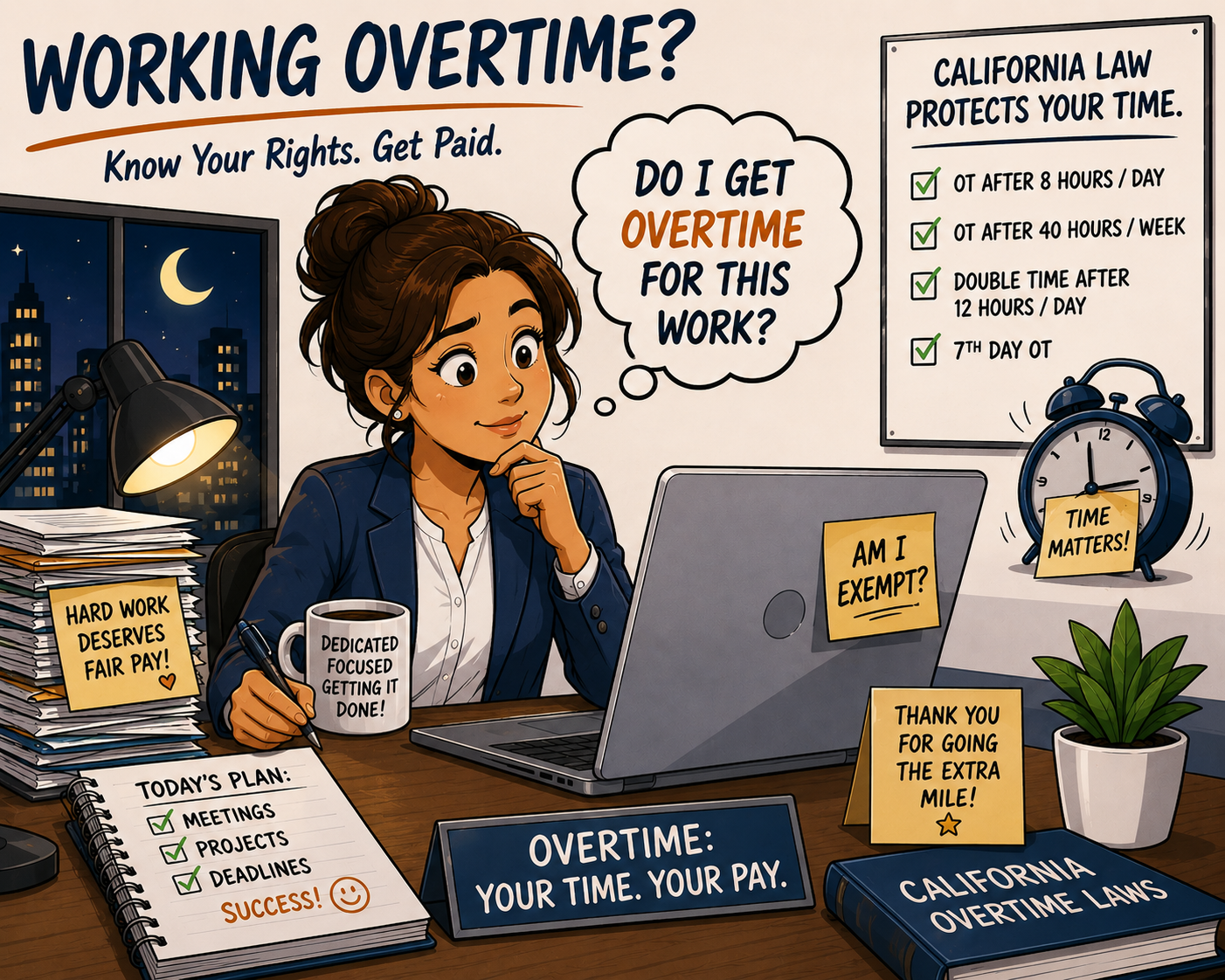
An Overtime Overview for California Law
California has some of the most comprehensive overtime requirements in the country. Under California law, nonexempt employees generally must receive premium compensation when they work beyond specified daily or weekly limits. Depending on the number of hours worked, overtime may be paid at either one and one-half times or two times the employee’s regular rate of pay.
California Labor Code section 510 establishes many of California’s principal overtime requirements. Additional requirements and exemptions are found in the California Labor Code and the applicable Industrial Welfare Commission (“IWC”) Wage Orders.
Employees who believe they have been denied legally required overtime compensation may file a wage claim with the California Labor Commissioner or, when appropriate, pursue a civil action to recover unpaid wages and other available remedies.
Importantly, being paid a salary does not automatically make an employee exempt from overtime. Whether an employee qualifies as exempt depends on the employee’s compensation, actual job duties, and the requirements of the particular exemption.
Who Is Entitled to Overtime Pay in California?
California’s overtime protections generally apply to nonexempt employees.
Under the standard overtime rules, nonexempt employees are generally entitled to overtime compensation for:
Hours worked in excess of eight hours in a workday;
Hours worked in excess of 40 hours in a workweek; and
The first eight hours worked on the seventh consecutive day of work in a workweek.
California law generally requires double-time compensation for:
Hours worked in excess of 12 hours in a workday; and
Hours worked in excess of eight hours on the seventh consecutive day of work in a workweek.
Different requirements may apply to employees covered by a valid alternative workweek schedule, collective bargaining agreement, industry-specific Wage Order, or another statutory exception.
Employees Subject to Exemptions or Special Overtime Rules
Not every worker is subject to California’s standard overtime requirements. Depending on the circumstances, exemptions or special rules may apply to:
Employees who satisfy an executive, administrative, or professional exemption;
Certain outside salespersons;
Certain employees covered by qualifying collective bargaining agreements;
Properly classified independent contractors;
Employees working under valid alternative workweek schedules;
Certain agricultural employees;
Certain household employees and personal attendants;
Certain employees working extended shifts in specified industries;
Certain resident managers;
Camp counselors;
Certain ski-industry employees;
Certain employees in the motion-picture industry; and
Other employees covered by occupation- or industry-specific rules.
Because California’s exemptions are highly fact-specific, an employer should not assume that an employee is exempt simply because of the employee’s job title, method of compensation, or industry.
California’s White-Collar Overtime Exemptions
California recognizes overtime exemptions for certain executive, administrative, and professional employees.
Generally, an employee seeking to qualify under one of these exemptions must satisfy both a duties test and a salary test.
Depending on the exemption, this typically requires the employee to:
Primarily perform qualifying executive, administrative, or professional duties;
Customarily and regularly exercise discretion and independent judgment where required by the applicable exemption;
Spend more than half of the employee’s working time performing exempt duties; and
Receive a salary that meets California’s applicable minimum salary threshold.
For many white-collar exemptions, the required salary is tied to twice the California minimum wage for full-time employment, based on a 40-hour workweek. Because California’s minimum wage can change, employers should verify the applicable threshold for the relevant year before classifying an employee as exempt.
Salary Alone Does Not Establish Exempt Status
Paying an employee a salary does not, by itself, eliminate the employer’s overtime obligations.
For example, suppose a hardware-store manager has authority to hire and terminate employees, makes meaningful purchasing and management decisions, and spends most of the workweek performing qualifying managerial duties. Even if the employee satisfies the applicable duties test, the employee may still be nonexempt if the salary does not meet California’s minimum compensation requirement for the exemption.
Employers should therefore evaluate both compensation and actual job duties before classifying an employee as exempt.
Outside Salespersons
California also provides an overtime exemption for qualifying outside salespersons.
Generally, the exemption applies when an employee:
Is at least 18 years old;
Customarily and regularly spends more than half of the employee’s working time away from the employer’s place of business; and
Is engaged in selling items, contracts, services, or the use of facilities.
The employee’s actual activities are important. A job title containing the word “sales” does not, by itself, establish the exemption.
Employees Covered by Collective Bargaining Agreements
Certain employees covered by qualifying collective bargaining agreements may be exempt from California’s statutory overtime requirements.
The exemption generally requires a collective bargaining agreement that:
Expressly provides for wages, hours of work, and working conditions;
Provides premium wage rates for overtime hours; and
Provides a regular hourly rate of pay that is at least 30% above California’s minimum wage.
If the collective bargaining agreement does not satisfy the applicable statutory requirements, California’s ordinary overtime protections may continue to apply.
Independent Contractors
Properly classified independent contractors are generally not entitled to employee overtime protections because they are not employees.
However, simply calling a worker an “independent contractor” does not determine the worker’s legal status. California has detailed worker-classification requirements, and the applicable legal test depends on the circumstances and the nature of the work.
A worker who has been misclassified as an independent contractor may potentially be entitled to unpaid overtime and other employment-law protections.
Alternative Workweek Schedules
California permits certain employees to work under a properly adopted alternative workweek schedule (“AWS”).
A valid AWS may permit employees to work more than eight hours in a workday without triggering daily overtime—for example, four 10-hour workdays.
Alternative workweek schedules are highly regulated. Among other requirements, a proposed schedule generally must be approved by at least two-thirds of the affected employees in a work unit through a secret-ballot election. Employers must also comply with applicable notice, reporting, and procedural requirements.
An AWS does not permit employees to work unlimited hours without overtime. Overtime may still be required when employees work beyond the hours authorized by the applicable schedule or exceed other statutory limits.
Employers considering an AWS should carefully review the requirements of the applicable Wage Order and California law before implementation.
Industry-Specific Overtime Rules
Certain industries and occupations are subject to specialized overtime provisions.
Camp Counselors
Under IWC Wage Order No. 5, qualifying camp counselors are subject to specialized overtime rules rather than the ordinary daily overtime provisions. Depending on the circumstances, overtime compensation may be required for hours worked beyond the applicable weekly or consecutive-day limits.
Ski-Industry Employees
Certain employees in the ski industry may be subject to special scheduling and overtime provisions under IWC Wage Order No. 10. The precise requirements depend on the employee’s duties, schedule, and whether the applicable statutory and Wage Order requirements are satisfied.
Minors
Special wage-and-hour rules may apply to minors, including restrictions on working hours and additional overtime requirements under the applicable Wage Order.
Motion-Picture “Extras”
Certain employees working as extras in the motion-picture industry are subject to industry-specific overtime requirements. Depending on the applicable Wage Order and hours worked, premium compensation may apply after specified daily thresholds.
Because industry-specific overtime provisions can differ substantially from California’s general rules, employers should identify the applicable Wage Order before determining an employee’s overtime entitlement.
When Is Overtime Required?
More Than Eight Hours in a Workday
A nonexempt employee generally earns overtime at one and one-half times the regular rate of pay for hours worked beyond eight and through 12 hours in a workday.
Hours worked beyond 12 in a workday generally must be compensated at twice the employee’s regular rate of pay.
A properly adopted alternative workweek schedule can modify the point at which daily overtime begins.
More Than 40 Hours in a Workweek
Nonexempt employees generally must receive overtime compensation when they work more than 40 hours in a single workweek.
A workweek is a fixed and regularly recurring period of seven consecutive 24-hour periods. An employer may establish when its workweek begins, subject to California law.
Working more than 40 hours during any arbitrary seven-day period does not necessarily establish weekly overtime if those hours fall within two separate, properly established workweeks.
Employers may establish different workweeks for different groups of employees when legitimately structured, but they may not manipulate workweek definitions for the purpose of evading overtime obligations.
Seventh Consecutive Day of Work
California’s overtime rules also address employees who work seven consecutive days within the same workweek.
A nonexempt employee generally receives:
Time-and-one-half for the first eight hours worked on the seventh consecutive day of work in the workweek; and
Double time for hours worked beyond eight on that seventh day.
Whether the seventh-day rule applies depends on the employer’s established workweek. Working seven calendar days in a row does not necessarily trigger seventh-day overtime when the days span two separate workweeks.
Employees Cannot Waive Their Right to Overtime
An employer and employee generally cannot agree to waive overtime compensation required by California law.
An agreement to pay straight-time wages for legally compensable overtime hours generally does not eliminate the employer’s obligation to pay the required overtime premium.
Understanding the Regular Rate of Pay
Calculating overtime requires determining the employee’s regular rate of pay.
The regular rate is not necessarily the same as the employee’s stated hourly wage. Depending on the employee’s compensation, the regular rate may include additional forms of remuneration.
Potential components can include:
Hourly wages;
Salary attributable to non-overtime hours;
Shift differentials;
Piece-rate compensation;
Commissions;
Nondiscretionary bonuses; and
Certain other forms of compensation.
The regular rate generally cannot be lower than the applicable minimum wage.
The California Supreme Court has also held that the “regular rate of compensation” used to calculate meal- and rest-period premium payments includes nondiscretionary payments in addition to an employee’s base hourly rate. See Ferra v. Loews Hollywood Hotel, LLC (2021) 11 Cal.5th 858.
Hourly Employees
For an employee receiving a single hourly rate, the starting point for determining the regular rate is generally the employee’s hourly wage.
Additional compensation that must legally be included in the regular rate—such as qualifying nondiscretionary bonuses or shift differentials—may increase the employee’s effective regular rate for overtime purposes.
Salaried Nonexempt Employees
A salaried employee may still be nonexempt.
When calculating the regular rate for a nonexempt salaried employee, the employer must determine the hourly value of the salary under the applicable California rules.
For a salary intended to compensate an employee for a standard 40-hour workweek, the calculation generally involves:
Determining the weekly salary; and
Dividing the weekly salary by 40 hours.
For monthly compensation, this can generally be calculated by:
Multiplying the monthly salary by 12 to determine annual compensation;
Dividing annual compensation by 52 to determine weekly compensation; and
Dividing the weekly compensation by 40 to determine the regular hourly rate.
The appropriate calculation can differ depending on the compensation arrangement.
Piece-Rate and Commission Employees
Employees paid on a piece-rate or commission basis may also be entitled to overtime.
Depending on the compensation structure, the regular rate may be determined by dividing qualifying compensation earned during the workweek by the appropriate number of hours worked.
Special rules can apply to piece-rate employees, commissioned employees, and employees whose compensation varies from week to week.
Employees Working at Multiple Rates
An employee may perform different types of work at different hourly rates during the same workweek.
In those circumstances, overtime is commonly calculated using a weighted-average regular rate, unless another legally permissible method applies.
For example, assume an employee works:
32 hours at $21 per hour; and
10 hours at $19 per hour.
The employee’s straight-time earnings would total $862:
(32 × $21) + (10 × $19) = $862
The weighted-average regular rate would then be determined by dividing $862 by the 42 hours worked:
$862 ÷ 42 = approximately $20.52 per hour
The applicable overtime premium would then be calculated using that regular rate, subject to California’s overtime rules.
Bonuses and the Regular Rate of Pay
Nondiscretionary Bonuses
Nondiscretionary bonuses generally must be included when determining an employee’s regular rate of pay.
These may include bonuses based on:
Hours worked;
Productivity;
Production;
Attendance;
Performance against predetermined criteria; or
Incentives promised in advance.
California applies specialized rules when calculating the regular rate attributable to certain bonuses.
Flat-Sum Bonuses
California law treats flat-sum bonuses differently from certain production-based bonuses.
For qualifying flat-sum bonuses, the bonus is generally allocated over the non-overtime hours worked during the bonus-earning period for purposes of determining the additional overtime premium attributable to the bonus.
Because bonus calculations can become complex, employers should carefully distinguish between flat-sum bonuses, production bonuses, commissions, and other incentive compensation.
Discretionary Bonuses and Other Excludable Payments
A truly discretionary bonus may be excluded from the regular rate when the employer retains discretion over both whether the bonus will be paid and the amount until at or near the end of the relevant period.
Other payments that may be excluded from the regular rate under appropriate circumstances include certain:
Expense reimbursements;
Vacation or holiday payments;
Payments for periods when no work is performed;
Gifts on special occasions; and
Qualifying premium payments.
Whether compensation can legally be excluded depends on the nature and purpose of the payment, not merely the label the employer gives it.
Must Employers Pay Unauthorized Overtime?
Yes.
California employers generally must pay employees for overtime they suffer or permit employees to work, even when the overtime was not authorized in advance.
An employer may maintain a policy requiring employees to obtain authorization before working overtime and may impose appropriate discipline for violating that policy. The employer, however, generally cannot refuse to pay compensation for overtime hours it knew or should have known were worked.
For most nonexempt employees, California generally requires:
1.5 times the regular rate for hours worked beyond eight and through 12 in a workday;
2 times the regular rate for hours worked beyond 12 in a workday;
1.5 times the regular rate for the first eight hours worked on the seventh consecutive day of work in a workweek; and
2 times the regular rate for hours worked beyond eight on the seventh consecutive day.
Employees also have an obligation to accurately report their working time. An employee generally cannot deliberately conceal overtime from an employer and later rely on the employer’s lack of knowledge.
Employers, however, remain responsible for maintaining accurate time records and paying for work they knew or reasonably should have known was being performed.
When Must Overtime Wages Be Paid?
Under Labor Code section 204, overtime wages generally must be paid no later than the regular payday for the payroll period following the payroll period in which the overtime was earned, when the overtime amount cannot reasonably be determined in time for the current payroll.
This limited timing rule does not permit employers to delay payment of ordinary straight-time wages that are otherwise due.
Employers should maintain payroll systems capable of identifying, calculating, and paying overtime compensation accurately and within the applicable statutory deadlines.
Recovering Unpaid Overtime
Employees who believe they have not received overtime compensation required by California law may have several options.
Depending on the circumstances, an employee may:
Raise the discrepancy with the employer or payroll department;
File a wage claim with the California Labor Commissioner;
Pursue a civil wage-and-hour action; or
Seek other remedies authorized by California law.
Available remedies may include unpaid overtime wages, interest, statutory penalties where applicable, and attorney’s fees and costs when authorized by law.
California law also prohibits unlawful retaliation against employees for exercising protected wage-and-hour rights.
Employer Overtime Compliance
California overtime compliance involves considerably more than determining whether an employee worked more than 40 hours during a week.
Employers should regularly review:
Employee exempt and nonexempt classifications;
Applicable IWC Wage Orders;
Daily and weekly overtime calculations;
Seventh-day overtime;
Alternative workweek schedules;
Timekeeping practices;
Off-the-clock work;
Bonuses, commissions, and other regular-rate components;
Payroll calculations;
Collective bargaining agreements;
Independent-contractor classifications; and
Industry-specific overtime requirements.
Employers should be particularly cautious when classifying salaried employees as exempt. Salary status and exempt status are not synonymous. An employee who fails either the applicable salary requirement or duties test may remain entitled to overtime compensation.
California Labor Code Section 510
Labor Code section 510(a) establishes California’s general daily, weekly, and seventh-day overtime requirements.
Because California overtime law contains numerous exemptions, exceptions, industry-specific rules, and specialized methods for calculating the regular rate of pay, employers should evaluate overtime compliance based on the circumstances of each workforce and compensation structure.
Legal Guidance for California Employers
Havey Law Offices LLC provides legal guidance to employers regarding California overtime laws, employee classifications, payroll practices, alternative workweek schedules, and wage-and-hour compliance.
Contact Havey Law Offices LLC to discuss your company’s obligations, identify potential compliance concerns, and develop practical strategies for reducing wage-and-hour risk.
This article is provided for general informational purposes and does not constitute legal advice. Reading this article or contacting the firm does not, by itself, create an attorney-client relationship.
Resources
Regular Rate of Pay
Advanced-Tech Security Services, Inc. v. Superior Court (2008) 163 Cal.App.4th 700.
Ferra v. Loews Hollywood Hotel, LLC (2021) 11 Cal.5th 858.
Naranjo v. Spectrum Security Services, Inc. (2022) 13 Cal.5th 93.
Overtime and Hours Worked
Seymore v. Metson Marine, Inc. (2011) 194 Cal.App.4th 361.
Griffin v. Sachs Electric Co. (N.D. Cal. 2019) 390 F.Supp.3d 1070.
Morillion v. Royal Packing Co. (2000) 22 Cal.4th 575.
Rutti v. Lojack Corp. (9th Cir. 2009) 578 F.3d 1084.
Alcantar v. Hobart Service (9th Cir. 2015) 800 F.3d 1047.
Wage Statements and Penalties
Maldonado v. Epsilon Plastics, Inc. (2018) 22 Cal.App.5th 1308.
Collective Bargaining Agreements
Vranish v. Exxon Mobil Corp. (2014) 223 Cal.App.4th 103.
Araquistain v. Pacific Gas & Electric Co. (2014) 229 Cal.App.4th 227.
Wage Claims, Class Actions, and PAGA
Razo v. AT&T Mobility Services, LLC (E.D. Cal. Apr. 26, 2023), No. 1:20-cv-0172-JLT-HBK.
Statutory Resources
California Labor Code
California Industrial Welfare Commission Wage Orders
California Labor Code section 510
California Labor Code section 204
California Private Attorneys General Act (“PAGA”)
Last Updated: August 2026
By: Heath A. Havey
Heath has been advising companies in California, Nevada, Japan, and U.S. employment laws since 1998.
Havey Law Offices LLC provides experienced legal guidance on California employment law and workplace compliance. Contact us today to discuss your company’s legal obligations, address potential compliance concerns, and develop practical strategies to reduce risk and maintain compliance with California employment laws.
Legal Disclaimer
The information provided on this blog is for general informational purposes only and does not constitute legal advice. Reading this blog, commenting on posts, or contacting the author through this website does not create an attorney–client relationship.
While we strive to ensure the accuracy and timeliness of the content, laws and regulations change frequently, and the information may not reflect the most current legal developments. You should consult a qualified attorney licensed in your jurisdiction before making any legal decisions or taking any action based on the information provided here.
The author and this blog disclaim all liability for any actions taken or not taken based on the content of this site. Use of this blog is at your own risk.