
Please be seated…
California Suitable Seating Laws: Employee Rights and Employer Obligations
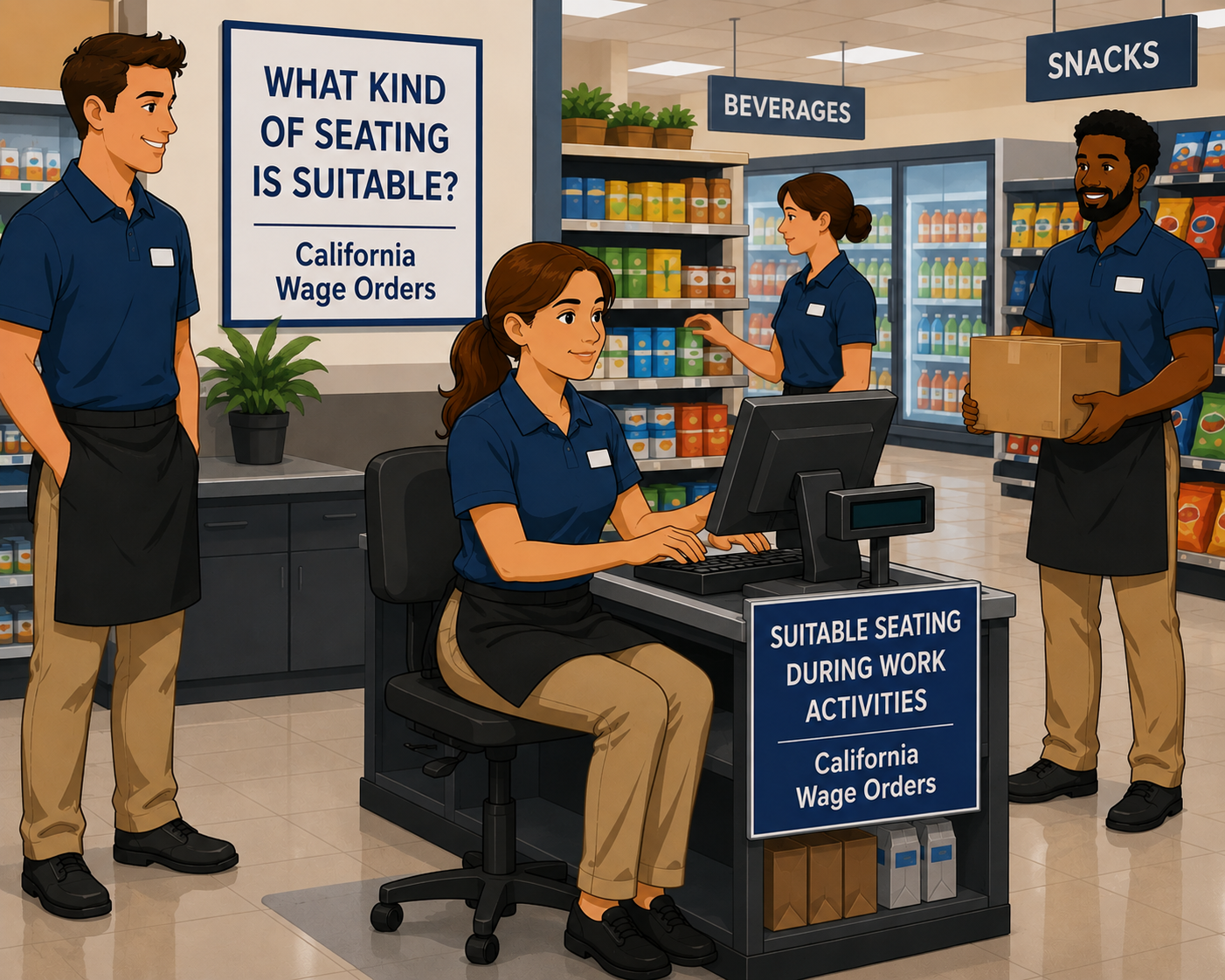
California’s wage-and-hour laws are governed primarily by the California Labor Code and a series of wage orders issued by the Industrial Welfare Commission (“IWC”).3 These wage orders are enforceable regulations that establish minimum standards governing wages, hours, and working conditions.4
The IWC has issued eighteen wage orders in total. Sixteen apply to specific industries or occupations, one applies to miscellaneous employees not covered by another wage order, and one establishes California’s general minimum wage requirements.5 The IWC maintains a complete list of wage orders on its website.
California’s suitable seating requirements date back more than a century. Seating provisions first appeared in IWC wage orders in 1919 and originally applied only to women and minors.6 The requirements were later expanded and now apply without regard to an employee’s age or gender.7
California’s Suitable Seating Requirements
Fourteen of the IWC’s sixteen industry- and occupation-specific wage orders contain substantially identical suitable seating provisions:
(A) All working employees shall be provided with suitable seats when the nature of the work reasonably permits the use of seats.
(B) When employees are not engaged in the active duties of their employment and the nature of the work requires standing, an adequate number of suitable seats shall be placed in reasonable proximity to the work area and employees shall be permitted to use such seats when it does not interfere with the performance of their duties.8
Two wage orders contain different seating requirements: Wage Order No. 14, which applies to agricultural occupations, and Wage Order No. 16, which applies to certain on-site occupations in the construction, drilling, logging, and mining industries.9
For agricultural occupations, Wage Order No. 14 provides:
When the nature of the work reasonably permits the use of seats, suitable seats shall be provided for employees working on or at a machine.10
For certain on-site occupations in the construction, drilling, logging, and mining industries, Wage Order No. 16 provides:
Where practicable and consistent with applicable industry-wide standards, all working employees shall be provided with suitable seats when the nature of the process and the work performed reasonably permits the use of seats. This section shall not exceed regulations promulgated by the Occupational Safety and Health Standards Board.11
Employees covered by Wage Order No. 17, which applies to miscellaneous occupations not covered by another industry-specific wage order, are not subject to a specific suitable seating requirement.12 In practice, however, Wage Order No. 17 applies to relatively few employees because California’s other wage orders broadly cover most occupations and industries.
Because Wage Orders Nos. 14, 16, and 17 apply in more limited circumstances, the discussion below focuses primarily on the suitable seating rules contained in the fourteen wage orders with the standard seating provisions.
Suitable Seating During Active Work
With limited exceptions, California employers must provide employees with suitable seats when the nature of the work reasonably permits seated work.13
The California Supreme Court has declined to establish a rigid test for determining when work “reasonably permits” the use of a seat. Instead, courts evaluate the particular circumstances of the job, including the employee’s tasks, work location, physical workspace, and operational requirements.
Determining the “Nature of the Work”
The first step is determining the “nature of the work.” The California Supreme Court has explained that this inquiry is both task-specific and location-specific.14
Courts examine the various tasks an employee performs at a particular location and determine whether those tasks can reasonably be performed while seated.15 Duties performed frequently or for extended periods generally carry more weight than duties performed only briefly or occasionally.16
The analysis focuses on the employee’s actual duties—not merely a job title, generalized job description, or an employer’s characterization of the position.17
Courts may also consider the duties ordinarily performed at the same location by other employees. The relevant question is whether the work itself reasonably permits seating, rather than whether a particular individual employee prefers or requires a seat.18
When the Work “Reasonably Permits” Seating
Whether the work reasonably permits seated performance depends on the totality of the circumstances.19
Two considerations are particularly important:
The nature of the tasks. Courts examine the employee’s duties at a particular location and determine whether those duties can be performed while seated or inherently require standing.20
The feasibility of providing a seat. Courts consider whether a seat would interfere with standing duties, whether frequent transitions between sitting and standing would disrupt the work, and whether seated work would affect the quality or effectiveness of the employee’s performance.21
Courts may consider additional workplace factors depending on the circumstances, and the importance given to each factor varies from case to case.22 23
Customer service expectations, for example, may be relevant.24 An employer may believe that standing employees appear more attentive or provide better service. However, customer service considerations are only one part of the analysis and must be evaluated alongside the employee’s actual duties and whether those duties can reasonably be performed while seated.25
An employer’s business judgment may also be considered, but it is not controlling. The standard is objective. An employer cannot avoid the seating requirement merely because management prefers that employees stand or has traditionally required certain duties to be performed while standing.26
The physical configuration of the workplace may also be relevant. If a seat can be incorporated into the work area without interfering with the employee’s standing duties or overall job performance, that fact may support a finding that seating is reasonable.27
Key Takeaway
In general, an employee is more likely to be entitled to a seat when most duties performed at a particular location can be completed while seated without interfering with the work.
By contrast, an employee may be less likely to have a right to sit when the job requires frequent movement between locations, repeated transitions between sitting and standing, or when seated work would materially interfere with standing duties or reduce the quality and effectiveness of overall job performance.28
The determination is highly fact-specific and depends on the employee’s actual work environment.
Suitable Seating During Lulls in Work
California’s suitable seating requirements also protect employees during periods when they remain on duty but are not actively performing work.
When employees are not engaged in active job duties and the nature of the work ordinarily requires standing, employers generally must provide an adequate number of suitable seats in reasonable proximity to the work area. Employees must be permitted to use those seats when doing so does not interfere with their duties.29
For example, consider a restaurant server whose primary duties involve taking orders and delivering food. During a period when the restaurant has no customers and the server has no immediate work to perform, the server may be experiencing a lull in operations. If no active duties require the employee to remain standing, the applicable wage order may require suitable seating to be available nearby.
The rules differ for employees covered by the agricultural wage order and certain construction, drilling, logging, and mining occupations.30 For those employees, the applicable wage orders generally tie the seating requirement to whether the nature of the work permits seating.31 They do not contain the same separate provision addressing seating during lulls in operations.32
Suitable Seating During Rest Breaks
California law generally requires nonexempt employees to receive a paid 10-minute rest period when they work more than three and one-half hours, subject to the applicable wage order and other legal requirements.
Employers must also provide suitable resting facilities in an area separate from toilet rooms and make those facilities available to employees during working hours.33
Although the wage orders do not provide detailed instructions regarding the type of seating that must be made available specifically during rest periods, employers should ensure that employees have access to suitable seating or resting facilities during their authorized breaks.
What Qualifies as a “Suitable” Seat?
California law does not provide a detailed definition of what constitutes “suitable seating.”
Whether a particular seat is suitable will therefore depend on the circumstances of the workplace, including the type of work being performed and the physical configuration of the work area.
In many workplaces, an ordinary chair, stool, or bench that safely supports the employee and allows the employee to perform assigned duties without unreasonable interference may satisfy the requirement.
However, suitability should be evaluated in the context of the particular job rather than under a one-size-fits-all standard.
Penalties for Violating California’s Suitable Seating Requirements
Employees generally do not have a direct private right of action for damages based solely on a violation of a wage order’s suitable seating provision. They may, however, have the ability to pursue civil penalties under California’s Private Attorneys General Act of 2004 (“PAGA”).34
PAGA allows an aggrieved employee, under specified circumstances, to pursue civil penalties on behalf of the State of California for Labor Code violations committed against the employee and other affected employees.35
For PAGA actions based on notices filed on or after June 19, 2024, an employee generally must have personally suffered each Labor Code violation asserted in the action and may seek penalties on behalf of other employees who experienced violations of the same provisions.36
Labor Code section 1198 gives the IWC wage orders the force of law.37 Accordingly, a violation of an applicable suitable seating provision may support a claim for civil penalties under PAGA when the statutory requirements are otherwise satisfied.
Potential PAGA Penalties
Under the current PAGA framework, potential civil penalties may include:
Default penalty: Generally, $100 for each aggrieved employee for each pay period in which the violation occurred.38
Enhanced penalty: A penalty of $200 per aggrieved employee per pay period may apply in more limited circumstances, including where a court or the Labor and Workforce Development Agency previously determined that the same policy or practice was unlawful within the preceding five years, or where the employer’s conduct was malicious, fraudulent, or oppressive.39
The 2024 amendments to PAGA also created mechanisms that may reduce potential penalties when employers take reasonable steps to comply with the Labor Code. The revised law includes cure procedures and penalty caps that may apply depending on when and how the employer addresses the alleged violation.40
How PAGA Penalties Are Distributed
PAGA civil penalties are divided between the State of California and the aggrieved employees.
For PAGA actions governed by the 2024 amendments, **65% of recovered civil penalties are paid to the Labor and Workforce Development Agency, while 35% are distributed to the aggrieved employees.**41
For actions based on PAGA notices filed before June 19, 2024, the former distribution formula generally applies, with 75% paid to the state and 25% distributed to the aggrieved employees.
Bringing a Suitable Seating Claim
Before bringing a PAGA action, an employee must comply with the statutory notice and administrative procedures established by Labor Code sections 2698 through 2699.5.
Because PAGA claims involve specific procedural requirements, deadlines, and potential defenses, employees considering a claim may wish to consult an attorney experienced in California wage-and-hour law.
PAGA also permits prevailing employees to recover reasonable attorney’s fees and costs in appropriate cases.42 As a result, attorneys handling these matters may accept suitable cases on a contingency-fee basis, depending on the circumstances.
Conclusion
California’s suitable seating laws are intended to prevent employers from requiring employees to stand unnecessarily when their work can reasonably be performed while seated.
Whether an employee is legally entitled to a seat depends on the nature of the work, the employee’s actual duties, the location where those duties are performed, the physical layout of the workspace, and whether providing a seat would interfere with effective job performance.
The California Supreme Court’s decision in Kilby v. CVS Pharmacy, Inc. makes clear that employers cannot rely solely on job titles, generalized descriptions, or a preference for standing employees. Instead, courts examine the actual work performed and determine objectively whether seating is reasonable under the totality of the circumstances.
Employees who believe they are being unlawfully denied suitable seating should consider documenting their work duties, the amount of time spent at particular workstations, whether those duties could reasonably be performed while seated, and any requests they have made for seating.
Because potential remedies—including PAGA penalties—can depend on highly specific facts and procedural requirements, employees with significant concerns may benefit from obtaining legal advice concerning their individual circumstances.
References
Cal. Code Regs., tit. 8, §§ 11010–11130, 11150, subd. 14(A). ↥
Cal. Code Regs., tit. 8, §§ 11010–11130, 11150, subd. 14(B). ↥
Cal. Const., art. XIV, § 1; Labor Code, § 1173. ↥
Mendiola v. CPS Security Solutions, Inc. (2015) 60 Cal.4th 833, 838. ↥
Martinez v. Combs (2010) 49 Cal.4th 35, 57; Cal. Code Regs., tit. 8, §§ 11000–11170. ↥
IWC Wage Order No. 7–68, Wages, Hours, and Working Conditions for Women and Minors in the Mercantile Industry (Feb. 1, 1968), § 18, former Cal. Admin. Code, tit. 8, § 11215–18, subd. (a). ↥
Kilby v. CVS Pharmacy, Inc. (2016) 63 Cal.4th 1, 13. ↥
Cal. Code Regs., tit. 8, §§ 11010, 11020, 11030, 11040, 11050, 11060, 11070, 11080, 11090, 11100, 11110, 11120, 11130, 11150. ↥
Cal. Code Regs., tit. 8, §§ 11140, 11160. ↥
Cal. Code Regs., tit. 8, § 11140, subd. 13. ↥
Cal. Code Regs., tit. 8, § 11160, subd. 12. ↥
Cal. Code Regs., tit. 8, § 11170. ↥
Cal. Code Regs., tit. 8, §§ 11010–11130, 11150, subd. 14. ↥
Kilby v. CVS Pharmacy, Inc. (2016) 63 Cal.4th 1, 18. ↥
Kilby v. CVS Pharmacy, Inc. (2016) 63 Cal.4th 1, 18. ↥
Kilby v. CVS Pharmacy, Inc. (2016) 63 Cal.4th 1, 18. ↥
Kilby v. CVS Pharmacy, Inc. (2016) 63 Cal.4th 1, 18. ↥
Kilby v. CVS Pharmacy, Inc. (2016) 63 Cal.4th 1, 23. ↥
Kilby v. CVS Pharmacy, Inc. (2016) 63 Cal.4th 1, 20. ↥
Kilby v. CVS Pharmacy, Inc. (2016) 63 Cal.4th 1, 19–20. ↥
Kilby v. CVS Pharmacy, Inc. (2016) 63 Cal.4th 1, 20. ↥
Kilby v. CVS Pharmacy, Inc. (2016) 63 Cal.4th 1, 20–21. ↥
Kilby v. CVS Pharmacy, Inc. (2016) 63 Cal.4th 1, 21. ↥
Kilby v. CVS Pharmacy, Inc. (2016) 63 Cal.4th 1, 21. ↥
Kilby v. CVS Pharmacy, Inc. (2016) 63 Cal.4th 1, 21. ↥
Kilby v. CVS Pharmacy, Inc. (2016) 63 Cal.4th 1, 21. ↥
Kilby v. CVS Pharmacy, Inc. (2016) 63 Cal.4th 1, 18. ↥
Kilby v. CVS Pharmacy, Inc. (2016) 63 Cal.4th 1, 18. ↥
Cal. Code Regs., tit. 8, §§ 11010, 11020, 11030, 11040, 11050, 11060, 11070, 11080, 11090, 11100, 11110, 11120, 11130, 11150, subd. 14(B). ↥
Cal. Code Regs., tit. 8, §§ 11140, 11160. ↥
Cal. Code Regs., tit. 8, §§ 11140, 11160. ↥
Cal. Code Regs., tit. 8, §§ 11140, 11160. ↥
Cal. Code Regs., tit. 8, §§ 11010, 11020, 11030, 11040, 11050, 11060, 11070, 11080, 11090, 11100, 11110, 11120, 11130, 11150, subd. 13(B). ↥
Labor Code, §§ 2698–2699.5. ↥
Iskanian v. CLS Transportation Los Angeles, LLC (2014) 59 Cal.4th 348, 360; see also Viking River Cruises, Inc. v. Moriana (2022) 596 U.S. 639. ↥
Labor Code, § 2699, subds. (a), (c)(1), as amended by Stats. 2024 (AB 2288, SB 92). ↥
Labor Code, § 1198. ↥
Labor Code, § 2699, subd. (f)(2)(A). ↥
Labor Code, § 2699, subd. (f)(2)(B). ↥
Labor Code, § 2699, subds. (g), (h); Labor Code, § 2699.3, as amended by Stats. 2024 (AB 2288, SB 92). ↥
Labor Code, § 2699, subd. (m). For PAGA actions based on a notice filed before June 19, 2024, the former 75%/25% allocation generally applies. ↥
Labor Code, § 2699, subd. (k)(1).